
Pushrods and Components
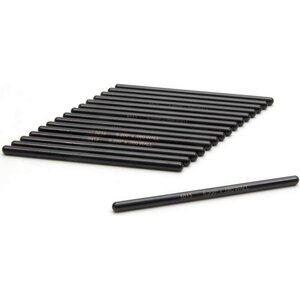
Many V8 enthusiasts believe that “a cheap pushrod is fine for street use.” And often, that’s true — until the RPM goes up, spring pressure increases, and the valvetrain begins to do its own thing. But how many have actually measured how straight that pushrod really is?
For street use, it’s often said: “within .010"–.015" you will be fine.”
But what happens when the runout is .020" (0.51 mm)? Or .030" (0.76 mm)?
And what about 0.25 mm (.010")?
Manufacturers rarely publish exact tolerance limits for pushrod straightness, but engine builders have long-established standards. The table below is based on guidelines from Trend Performance, Smith Brothers, and Comp Cams — as well as practices used in NHRA Pro Stock engine rooms.
| Application Level | Runout (in) | Runout (mm) | Notes |
|---|---|---|---|
| OE / Light Street | ≤ .020" | (≤ 0.50 mm) | Generally accepted tolerance for basic builds. Works well at low RPM if geometry allows. |
| Performance Street / Mild Race | ≤ .005" | (≤ 0.13 mm) | Recommended tolerance. Improves valvetrain stability. Suitable up to around 6500 RPM. |
| Race | ≤ .003" | (≤ 0.08 mm) | Typical threshold for serious race use. Even small deflection increases rocker resonance. |
| Pro / Top Level | ≤ .001" | (≤ 0.025 mm) | Common in Pro Stock and Top Sportsman. Often checked to within 0.0005". |
⚠️ Note: Manufacturers do not publish official straightness tolerances. These numbers reflect real-world engine builder standards and technical guidance from major valvetrain suppliers.
ℹ️ Practical Insight:
Pushrods — like many precision engine components — always have some manufacturing tolerance. Perfect “laser-straight” rods don’t really exist, even in top-level racing.
That’s why professional engine builders often order 20 pushrods and pick the 16 straightest ones for the engine. It’s the same principle used with main bearings or crankshaft bearing fits.
A small amount of runout, for example ≤ 0.25 mm (.010"), is completely normal and does not affect performance in a properly set up valvetrain. This is not a defect — it’s part of the normal manufacturing and building process. If the runout exceeds accepted limits or the part is clearly defective, of course, it will be replaced under normal warranty.
⚙️ Straightness directly impacts valve timing, wear, and resonance. Even a .010" (0.25 mm) deflection is enough to change rocker arm motion and accelerate component wear.
These tolerances are based on Trend Performance, Smith Brothers, Comp Cams technical data, and Pro Stock engine building practices.
Pushrod stiffness and resonance characteristics are determined primarily by its diameter and wall thickness. Here are the most common options:
| Diameter (in) | Wall (in) | Diameter (mm) | Wall (mm) | Application | Comment |
|---|---|---|---|---|---|
| 5/16" | 0.080" | 7.94 mm | 2.03 mm | Light street, OE | Affordable and often sufficient |
| 3/8" | 0.135" | 9.53 mm | 3.43 mm | Street / race | Good balance between cost and performance |
| 7/16" | 0.165" | 11.11 mm | 4.19 mm | Race, drag, high spring pressure | Maximum stiffness |
Rule of thumb: Always use the largest pushrod that physically fits your engine.
⚙️ Weight is not a concern here — the pushrod is on the “push” side of the valvetrain, not on the moving valve end.
We developed this tool because none of the commercial options offered what’s actually needed:
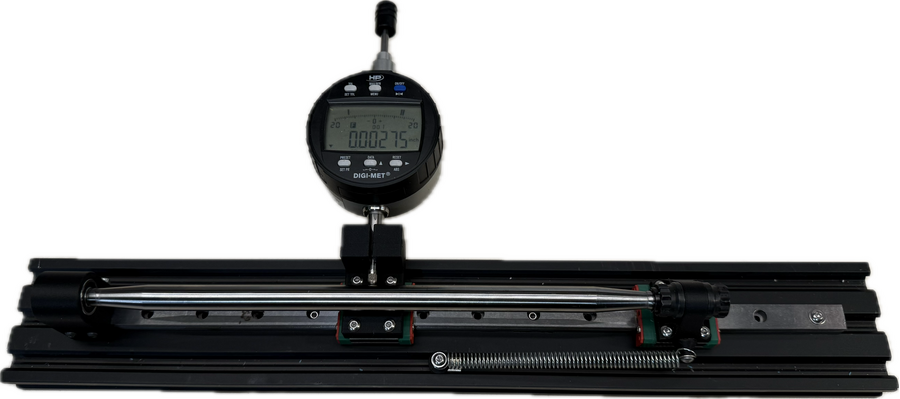
The new Trueline Pushrod Checker will be available soon.
⚠️ This is not just another tool — it reveals what your eyes can’t see and what manufacturers don’t tell you.
Pushrod straightness and construction affect everything — valvetrain stability, wear, power, and reliability.
That’s why you measure. That’s why you choose smart.
That’s why: Trueline Pushrod Checker.
And why: go with the largest, stiffest pushrod that fits — use your builder’s instinct.